
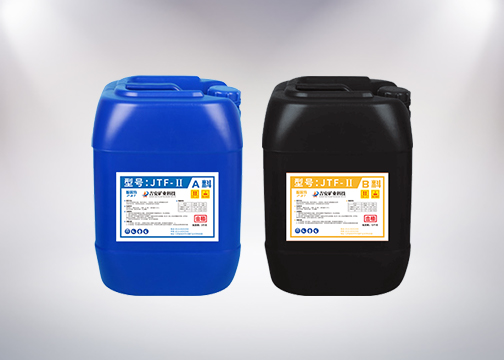
JTF‑Ⅱ targets coal spontaneous combustion in roadways, support tops and air leakage at upper and lower corners. Materials A and B mixed at a 1:1 ratio form cured foam with over 10‑fold expansion without heat generation, avoiding the high heat release of traditional polyurethane fillers. With low initial viscosity, it penetrates well into broken coal and goafs, forming a dense structure with excellent sealing, heat absorption and cooling performance.
Technical Overview
The new Purite Ⅱ fire prevention and extinguishing technology is developed to address the problems of coal spontaneous combustion in local areas (such as roadways and the top of supports) and air leakage prevention & sealing at upper and lower corners. It consists of two components, namely Material A and Material B, which are mixed at a volume ratio of 1:1. After chemical foaming, a cured foam is formed, with an expansion coefficient of more than 10 times. No heat is generated during the formation process, which fundamentally solves the shortcoming of traditional polyurethane-based filling materials that produce large amounts of heat during the reaction. After foaming, the product is in the form of foam with low initial viscosity. When injected into the cavities of broken coal-rock masses or goafs, it exhibits excellent diffusion and penetration performance. The finally formed cured foam can integrate with coal-rock masses to form a dense consolidated structure. Containing a certain amount of water, the cured foam has good sealing performance as well as heat absorption and cooling performance.
Technical Characteristics
(1) Foaming and Curing at Room Temperature:Innovative foaming technology is adopted. Neither the foaming process nor the curing process releases heat, and no heat is emitted to the surrounding environment.
(2) Excellent Diffusion Performance:After foaming, the material initially presents as emulsified foam with good fluidity and diffusion. It achieves an ideal filling effect in broken coal-rock masses, and can fully fill surrounding cavities and coal-rock fractures after curing.
(3) Excellent Flame Retardancy and Thermal Stability:The cured foam does not collapse, burn, or support combustion when continuously exposed to high-temperature fire sources above 800°C, reaching the highest level of flame retardancy.
(4) Excellent Sealing Performance:The cured foam has a high closed-cell rate and low air permeability. Meanwhile, the cured foam bonds integrally with coal-rock masses, which can effectively fill cavities and fractures and has excellent performance in air leakage prevention and sealing.
(5) Anti-Static Performance: The cured foam contains a certain amount of water and thus possesses natural anti-static performance.
Fire Prevention and Extinguishing Performance
(1) Foaming at Room Temperature and Curing at Room Temperature
Neither the foaming process nor the consolidation process generates heat (test conducted in winter), and the temperature remains comparable to the ambient temperature both before and after the reaction.
(2) Goaf Diffusion Performance
In the initial stage after foaming, it presents as emulsified foam with excellent diffusion performance. It achieves an ideal filling effect in broken coal-rock masses, and after curing, it can fully fill the surrounding cavities and coal-rock fractures.
(3) Flame Retardancy and Thermal Stability
The cured foam exhibits excellent flame retardancy. It does not collapse, burn, or support combustion even under the exposure to high-temperature fire sources.
(4) Free Space Stacking Performance
The free stacking angle can reach 45°, which is conducive to filling large spaces. This avoids the inability to stack at high positions in open spaces and reduces material waste.
Application Location
(1) Filling and sealing of air leakage channels in the goafs at the upper and lower corners;
(2) Filling and sealing of air leakage channels between working face supports and in the shallow goafs behind the supports;
(3) Filling and sealing of abandoned old roadways and closed roadways;
(4) Prevention and control of coal spontaneous combustion in local areas such as roadways and the top of supports;
(5) Prevention and control of local spontaneous combustion fires in overhead areas and behind supports;
(6) Construction of temporary fire-proof airtight walls or rapid airtight walls;
(7) Blocking of toxic and harmful gases underground.
Application Process
Material A and Material B are respectively added into the Purite preparation system at a volume ratio of 1:1 via dedicated equipment, producing Purite Ⅱ.