


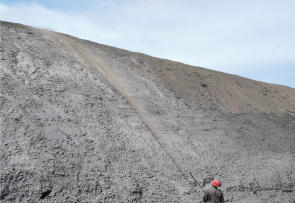
At the port’s coal yard, there are 441,600 tons of Australian coal stored. Affected by national policies, customs clear- ance and stacking of Australian coal have been suspended since September 2020. As the storage time has lengthened, the temperature of the coal piles has gradually increased, and some piles have repeatedly shown spontaneous combus- tion hot spots. Since November 2020, the port company has adopted various measures, including covering the piles with geotextile impermeable membranes and imported black-and-white membranes. However, it was found that the geotex- tile impermeable membranes and imported black-and-white membranes had poor sealing performance and could not be effectively secured in strong winds and heavy rain, resulting in high damage rates. Once the coal pile temperature exceeds 70°C, the covering cloth can also be ignited.
At the site, a whole pile of Australian coal (about 50,000 tons) was selected, and the highest temperature of the pile reached 88°C. The pile was divided into the sea side and the land side; the sea side was sprayed with a new type of sealing material, while no other measures were taken on the land side. After spraying the sealing material, distributed tempera- ture measurement points were arranged, and daily temperature measurements were taken on both the sea and land sides. The measured data were compiled, and temperature-time trend charts were drawn for comparison to verify the effectiveness of the sealing material.
The experiment showed:① The temperature on the sea side sprayed with the new sealing material was 9–12°C lower than that on the unsprayed land side.② After spraying the new sealing material, the coal pile temperature decreased daily and later stabilized at an average of 35°C.③ For the same coal type, the temperature of coal pile No. 7 in the yard, which was sprayed with the new sealing material, was 12–15°C lower than that on the sea side of coal pile No. 8 at the same meter position.④ After spraying the new sealing material, the temperature at each point gradually decreased. After market research and combined with the experimental results, Zhejiang Energy Port Company decided to purchase the new sealing material through targeted negotiations, and the purchase was approved by the group company.
Project Overview
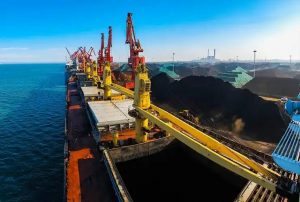
A coal terminal at a major port, located at the core hub of the Yangtze River Economic Belt, has six open-air strip coal yards with a total storage capacity of 1.28 million tons. It is equipped with four bridge-type grab ship unloaders, 57 belt conveyors, and five bucket-wheel stacker-reclaimers, forming a fully automated operation chain for “unloading–conveying–stacking/reclaiming”. The annual throughput exceeds 10 million tons, of which more than 60% of the imported coal is Indonesian lignite. Due to bottlenecks in transshipment efficiency within the river, the coal storage period has been passively extended to more than 60 days, far exceeding the 40-day safety threshold. This has caused the core temperature of the piles to exceed 70°C, releasing H₂S gas and accumulating hidden dangers of spontaneous combustion. This risk is further catalyzed by the combination of heat storage during sea transportation and closed transportation along the Yangtze River, leading to:
Transportation hazards: CO concentration in the closed cargo hold exceeds 2,000 ppm, and signs of spontaneous combustion have already appeared during the Yangtze River transportation stage, posing a fire risk.
Vicious cycle: Annual expenses for extended storage exceed 10 million yuan; spontaneous combustion causes loss of coal calorific value, accompanied by pressure from environmental penalties.
Turnover dilemma: Spontaneous combustion risk → shipping refusal → prolonged storage period → risk escalation, forming a systemic negative cycle.
Governance Plan
In response to the full-chain risk at the port — “heat storage during sea transportation → overdue storage → spontaneous combustion during Yangtze River transportation” — this plan adopts a dual-track technology of oxygen suppression at the source and physical isolation to break the inevitability of spontaneous combustion. The specific implementation path is as follows:
Blending coal oxygen inhibitor during loading
At the stage of loading coal into the ship’s hold, a coal oxygen inhibitor is blended in to suppress the coal-oxygen binding activity through molecular penetration. Two flexible adaptation options are provided:
Option 1: Independent blending device — The device is standalone and can perform blending before loading. Initial transformation costs are low, but later operational efficiency is low.
Option 2: Belt-conveyor retrofitted blending device — Modified on the belt conveyor system to enable blending during the loading process, with high operational efficiency.
Auxiliary measures: After loading is completed, a sealing material is sprayed on the coal surface to form an oxygen-isolating film of more than 2 mm, resisting rainwater erosion and inhibiting surface coal oxidation and temperature rise.
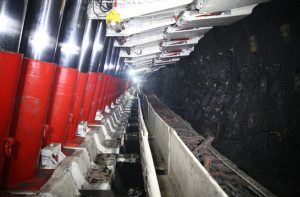
The No.110 fully-mechanized top‑coal caving face of the mine mines the No.10 and No.11 coal seams, with a dirt band between them. The total thickness of the two coal seams is about 6 meters. The coal seams are prone to spontaneous combustion, belonging to Class Ⅱ spontaneous combustion coal seams with a spontaneous combustion period of 80 days. The mine is a low‑gas mine with low gas emission.
The face adopts the fully-mechanized retreating top-coal caving mining method, and the roof is managed by the full caving method. Two roadways are arranged, with the belt gateway used as the return airway. Due to the shallow burial depth of the face and the existence of small kiln goafs in the overlying strata, positive pressure ventilation is continuously adopted to avoid external air leakage and gas intrusion.
Abnormal CO was detected at the upper corner of the No.110 face, and the CO concentration rose to approximately 120 ppm. It was analyzed that the residual coal in the adjacent No.108 goaf experienced oxidation and spontaneous combustion due to the large amount of residual coal and the influence of air leakage. The face was subsequently shut down for the Spring Festival holiday. To prevent intensified oxidation of residual coal in the goaf, which would pose a serious threat to safe production, it was urgent to take corresponding prevention and control measures.
In view of the above situation, Purite Special Mine Fire Extinguishing Liquid (JTF-Ⅰ) and its supporting application equipment developed by our company were applied. Grouting boreholes were arranged at the corners and between supports of the No.110 face to implement the material. As a result, the residual coal in the goaf was effectively insulated from oxygen and cooled, preventing further oxidation and spread. The CO concentration at the return corner and between supports of the face decreased steadily, ensuring the subsequent safe and rapid advancement of the No.110 face and the safe production of the mine.
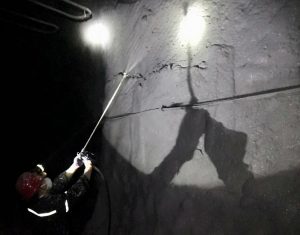
The coal seams of this mine have a tendency toward spontaneous combustion, with a spontaneous combustion tendency grade of Ⅱ and a minimum spontaneous combustion period of 60 days. The No.3 Upper 603 working face has an average coal seam thickness of 5m, and is mined by the strike longwall retreating full-seam fully-mechanized mining method, with a total advancing strike length of 370m.
According to the working face succession plan for resources under protective pressure in the East No.6 mining area, the working face needs to be stopped for approximately 8 months. Bolt-mesh support was installed on the coal wall to prevent rib spalling in front of the working face. However, construction inevitably caused partial coal fragmentation and fractures. With reduced air velocity at the working face and prolonged direct contact between broken coal and oxygen, partial coal oxidation and spontaneous combustion could occur.
In response to the above situation, Gainike Plastic Spray Sealing Material (JPF-Ⅲ) developed by our company and its supporting application equipment were introduced. Spray sealing construction was carried out on the coal wall surface in front of the No.3 Upper 603 working face, covering 20m of the material roadway and 70m of the transportation (return air) roadway.
After applying this fire prevention and extinguishing material, a dense sealing coating formed on the coal surface of the working face and two roadways, blocking contact between coal and oxygen to prevent coal oxidation and spontaneous combustion. Meanwhile, metal supports such as metal mesh and bolts were effectively protected, preventing metal corrosion and support failure.
This construction achieved the goal of preventing coal oxidation and spontaneous combustion at the working face, ensured safe mine production, brought considerable economic and social benefits to the mine, and provided new ideas and methods for its fire prevention and control work.