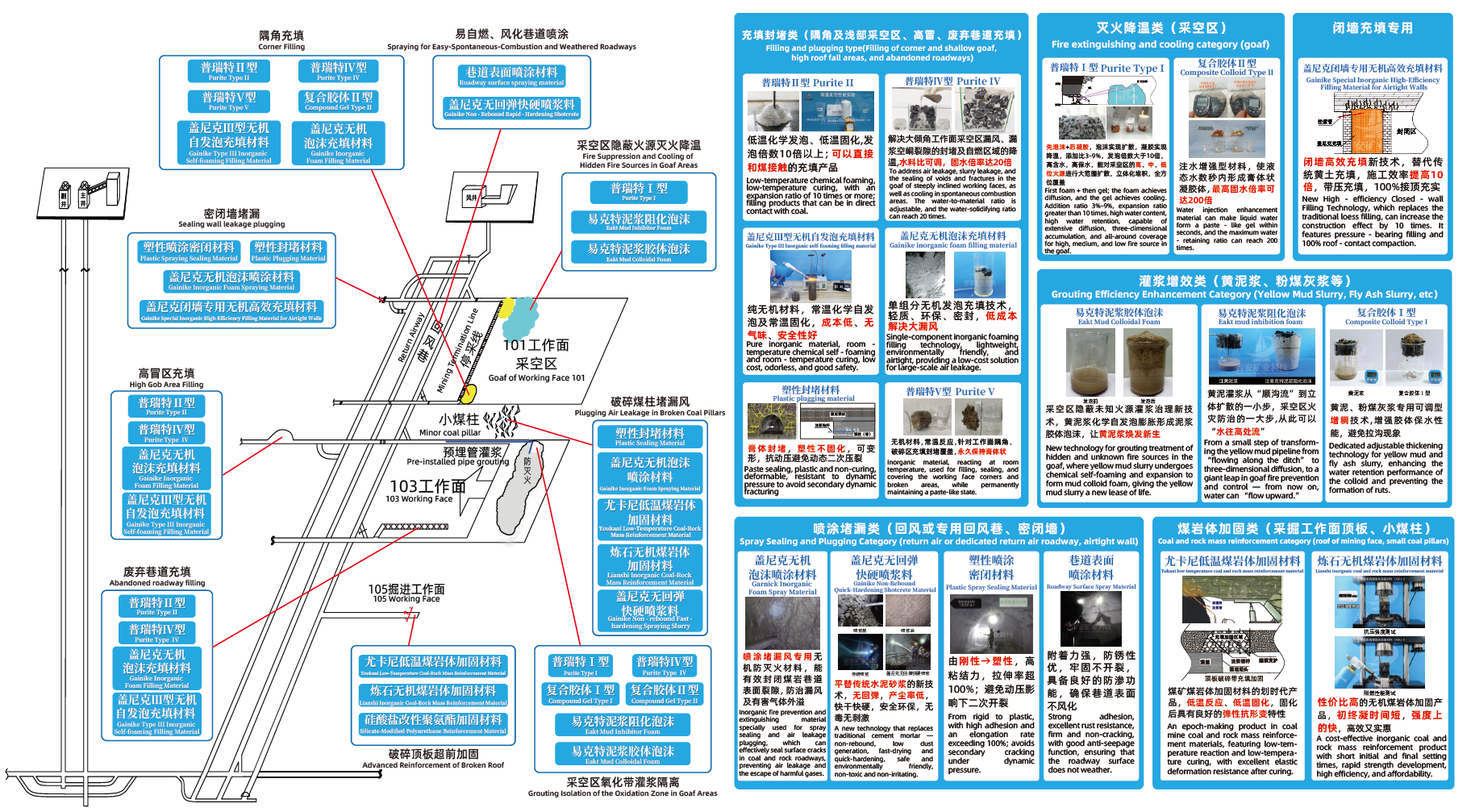
The core of underground coal mine fire control lies in the prevention and control of coal spontaneous combustion. It addresses residual coal oxidation, air leakage, oxygen supply, and heat accumulation across various mining scenarios by establishing an integrated technical system featuring advanced prevention, precise sealing, efficient fire extinguishing, and long-term combustion inhibition. This system enables early identification and control of spontaneous combustion hazards, prevents major fire accidents, and ensures safe mine operation.
1. Key Scenarios and Governance Logic of Coal Spontaneous Combustion
Underground coal mine fires mostly occur in hidden areas such as goafs, broken coal pillars, high-level caving zones, abandoned roadways, and corner areas due to continuous oxidation and heat storage. Given the differences in air leakage and residual coal distribution in each area, targeted technologies are required:
- Goaf Oxidation Zone: Stable air leakage and wide residual coal distribution easily meet spontaneous combustion conditions, requiring oxidation isolation and oxygen cutoff.
- Hidden Fire Source in Goaf: Concentrated residual coal, continuous air leakage, and concealed fire sources easily cause temperature rise and ignition, requiring cooling, fire extinguishing, and long-term inhibition.
- Corner Areas: Large air leakage, accumulated residual coal, and poor heat dissipation require foam filling, air leakage sealing, and residual coal encapsulation.
- Spontaneous & Weathered Roadways: Broken coal mass and air leakage lead to long-term oxidation, requiring spray sealing and oxygen isolation.
- Sealed Walls: Prone to air leakage and incomplete roof contact, requiring filling and sealing to cut off oxygen supply.
- High-level Caving Zones: Accumulated residual coal and poor ventilation cause heat buildup, requiring full-area foam filling and oxygen isolation.
- Abandoned Roadways: Large amounts of residual coal and continuous air leakage form hidden fire points, requiring full-section filling and complete oxygen cutoff.
- Broken Coal Pillars: Developed fractures and multiple air leakage paths require coal pillar reinforcement and fracture sealing.
- Broken Roofs: Severe air leakage and accumulated floating coal require advanced reinforcement, fracture sealing, and air leakage reduction.
2. Classification and Characteristics of Spontaneous Combustion Control Materials
1) Filling & Sealing Materials
- Purite Fire Extinguishing Material (JTF-Ⅱ): Low-temperature chemical foaming, expansion ratio > 10×, direct contact with coal allowed.
- Purite Fire Extinguishing Material (JTF-Ⅳ): For air leakage and fracture sealing in steeply dipping working faces; water-solid ratio adjustable, water retention up to 30×.
- Gainike Inorganic Self-Foaming Filling Material (JWT-Ⅲ): Inorganic self-foaming filling material, room-temperature curing, low-cost, odorless, safe.
- Gainike Inorganic Foam Filling Material (JWT-Ⅰ/Ⅰ): Single-component inorganic foam, lightweight, eco-friendly, high-sealing.
- Plastic Sealing Material (FSD-Ⅰ): Paste-type, non-curing, deformable, dynamic pressure resistant.
- Purite Fire Prevention And Extinguishing Material (JTF-Ⅴ): Inorganic material, room-temperature reaction, permanently paste-like for corner and broken zones.
2) Fire Extinguishing & Cooling Materials
- Purite Special Mine Fire Extinguishing Liquid (JTF-Ⅰ): Foam first for diffusion, then gel for cooling; expansion ratio > 20×, high water content and retention.
- Composite Gel (High Water-Retention Hydrogel) (MAG-Ⅱ): Quick gel formation from water, maximum water retention up to 200×.
3) Special Sealed Wall Filling
- Gainike Inorganic High-Efficiency Filling Material For Closed Wall (JCT-Ⅰ): Replaces loess filling, 10× construction efficiency, pressure filling, 100% roof contact.
4) Grouting Enhancement Materials
- Eakt Slurry Colloidal Foam (FJP-Ⅱ): Chemically foamed yellow mud for hidden fire source treatment.
- Eakt Mud Inhibiting Foam (FJP-Ⅰ): Enables “water flowing upward” and three-dimensional diffusion.
- Composite Gel (High Water-Retention Hydrogel) (MAG-Ⅰ): Thickening agent for yellow mud/fly ash slurry to prevent channeling.
5) Spray & Leakage Sealing Materials
- Gainike Inorganic Foam Spraying Material (JWT-Ⅰ/P): Seals roadway surface fractures and controls gas emission.
- Gainike Non-Rebound Rapid-Hardening Spraying Material (JPW-Ⅰ): Replaces cement mortar, low dust, fast curing, eco-friendly.
- Gainike Plastic Spraying Sealing Material (JPF-Ⅲ): High adhesion, elongation >100%, anti-cracking under dynamic pressure.
- Gainike Roadway Surface Spraying Sealing Material (JPF-Ⅰ): Strong adhesion, anti-weathering, anti-seepage.
6) Coal-Rock Mass Reinforcement Materials
- Youkani Low-Temperature Coal And Rock Mass Reinforcement Material (KDJ-Ⅱ): Low-temp reaction and curing, elastic and deformation-resistant.
- Lianshi Inorganic Coal And Rock Mass Reinforcement Material (KWJ-Ⅰ): Fast setting, high strength, cost-effective.
Coal spontaneous combustion control is a systematic project critical to safe mining operations throughout the mine life cycle, focusing on scenario-based precise governance and full-process technical collaboration. Based on independently developed fire prevention and extinguishing materials, we have built a comprehensive solution integrating early warning and prevention, precise sealing and oxygen isolation, efficient fire extinguishing and cooling, and long-term combustion inhibition for key risk areas such as goafs, corners, and roadways, achieving a shift from passive emergency response to active intelligent prevention.
This system effectively controls spontaneous combustion hazards, prevents major fires, and protects personnel safety and production stability. With eco-friendly, efficient, economical, and long-lasting advantages, it provides reliable global solutions for coal mines. Moving forward, we will continue to innovate technologies and materials, integrate intelligent and digital applications, and advance underground coal mine fire control toward precision, efficiency, greenness, and intelligence, building a solid safety barrier for global energy security and sustainable mining development.